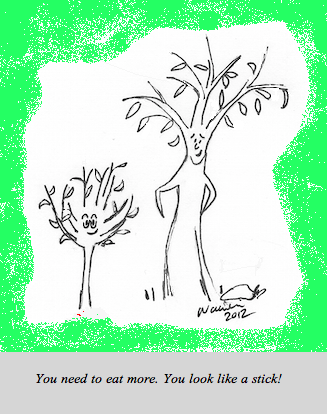
Your child’s pediatrician charts your child’s height and weight in order to determine whether he is growing appropriately. Some kids are underweight. These kids use more calories than they take in.
Here are ways to increase calories. Remember, it’s not as simple as demanding that your child eat more of her noodles. Instead of trying to stuff more food into your child, increase the caloric umph behind each meal.
Make every bite count:
Mix baby cereal with breast milk or formula, not juice or water.
After weaning from formula or breast milk at a year of age, give whole milk until two years, longer if your pediatrician recommends this. Cow’s milk has more calories than rice, oat, or nut milks.
Add Carnation Breakfast Essentials to milk.
Add Smart Balance, butter, or olive oil to cooked vegetables, pasta, rice, and hot cereal.
Dip fruit into whole milk yogurt
Dip vegetables into cheese sauce or ranch dressing
Offer avocado and banana over less caloric fruits such as grapes (which contain only one calorie per grape).
Cream cheese is full of calories and flavor: smear some on raw veggies, whole wheat crackers, or add some to a jelly sandwich.
Peanut butter and other nut-butters are great ways to add calories as well as protein to crackers, sandwiches, and cereal.
If your child is old enough to eat nuts without choking (as least 3 years), a snack of nuts provides more calories and nutrition than crackers.
For your older child, feed hardy “home style foods.” Give mac ‘n cheese instead of pasta with tomato sauce.
In general, any form of meat (chicken, fish, or other meat) is more calorically dense than most other foods.
Mix granola into yogurt.
Give a hard boiled egg or pieces of cheese as a snack.
For those who don’t like plain egg, try French toast!
Give milkshakes in place of milk (no raw eggs!).
Choose a muffin over a piece of toast.
Butter their waffles and pancakes before serving.
Have your child’s pediatrician exclude medical reasons of poor weight gain with a thorough history and physical exam before you assume poor weight gain is from low caloric intake.
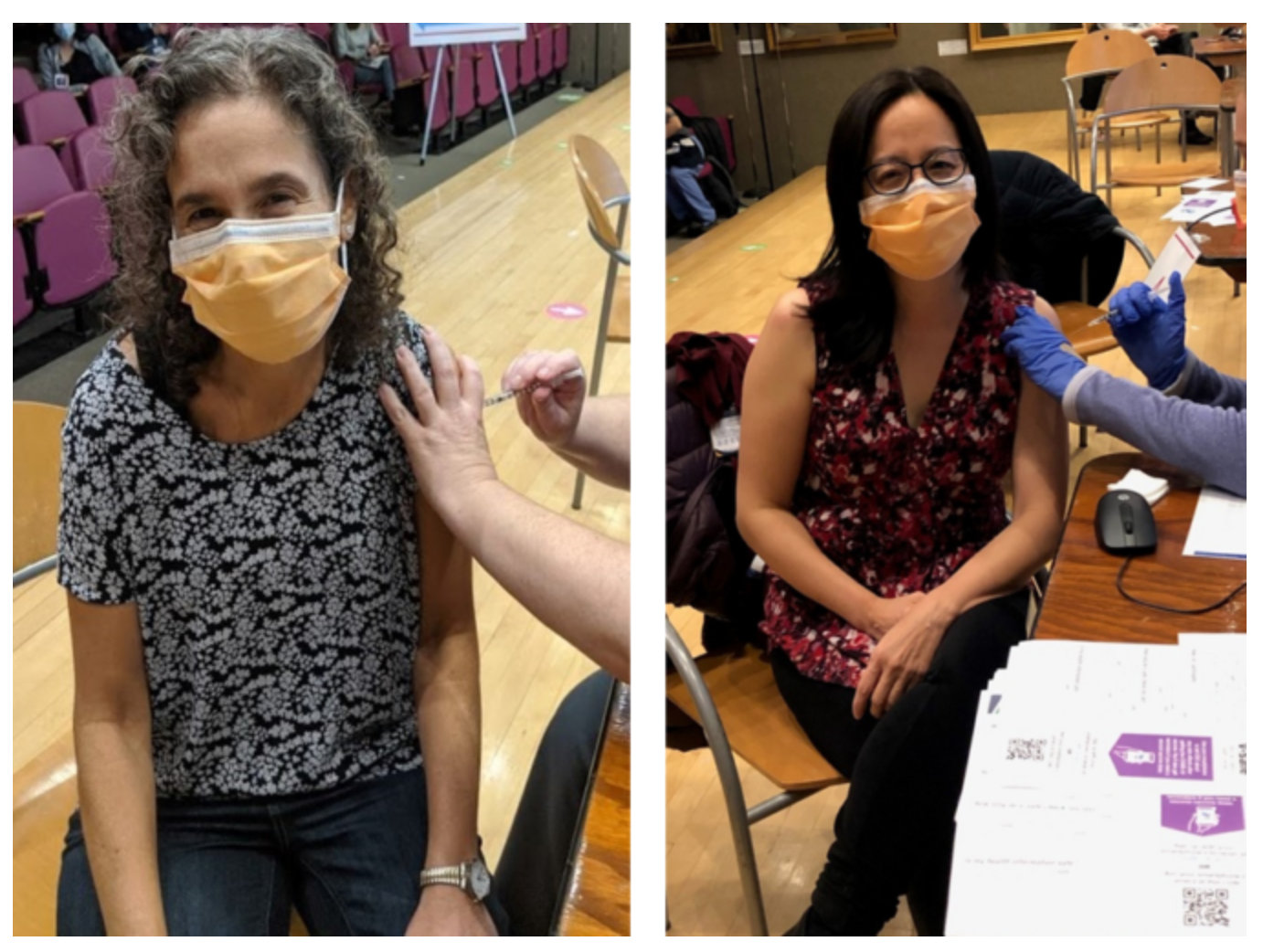
As the year 2020 comes to a close, we are grateful, as pediatricians caring for your children, that we received our first doses of COVID-19 vaccine.
There is hope! COVID-19 vaccines have arrived and more than two million adults have safely received a vaccine. Now that vaccinations are reaching adults, many families wonder when COVID-19 vaccines will be available for their children.
Of the two Food and Drug Administration approved COVID-19 vaccines in the United States, Pfizer-BioNtech’s vaccine is authorized for ages 16 and up and Moderna’s vaccine is authorized for those ages 18 and up. For kids 12 years old and up, trials are still ongoing. Pfizer-BioNtech began trials in October and Moderna began earlier this month. With this in mind, vaccines for tween and teens will probably not be available for months. Since trials have not started for younger children, expect vaccine availability to take even longer.
For now, the vaccination of adults may provide some protection to children until they too can receive the vaccine. Until then, we will continue to wear masks, distance, and wash hands often.
In addition to pocket-sized hand sanitizer, I recently got my kids pocket-sized moisturizer to help their dry, cracked hands.
Between diligent handwashing and falling temperatures in Pennsylvania, we are experiencing annoying, itchy skin changes. We’ve blogged about this before-Dr. Lai and I are used to washing our hands twice for every patient we see in the office-once before examining them and once again afterward. I have a jar of moisturizer on my desk that I frequently dip into between patients. Now I remind my kids to do the same between hand washings.
Here are some remedies to help treat dry, cracked hands:
Petroleum jelly, such as Vasoline or Aquaphor, works great to moisturize and heal cracks in the skin. Apply at bedtime. Ointments are greasy, so during the day your kids might prefer using a fragrance-free moisturizing cream such as CeraVe or Aveeno.
If itchy, add hydrocortisone 1% ointment to your kids’ daily or twice daily hand-care regime. Sometimes, for kids with underlying eczema, pediatricians prescribe a stronger type of hydrocortisone to help with more severe skin cracking and itching from dryness. Ointment tends to sting less than cream.
Mix equal parts of moisturizing ointment and hydrocortisone ointment, smear, and put socks over hands to lock in moisture. This works best as a bedtime routine to help decrease the subconscious scratching and picking that occurs during sleep.
Also stop the itch by giving your child an oral antihistamine such as cetirizine (Zyrtec).
Of course, an ounce of prevention is worth a pound of cure. Here are ways to prevent dry, cracked hands:
Encourage your children to wear gloves or mittens when outside in cold weather. This shields skin from drying out.
Apply moisturizer to hands before leaving the house every day.
Keep moisturizer next to all sinks in the house to remind your kids to moisturize after handwashing. Their hands do not have to be completely dry before applying the moisturizer- in fact, moisturizing cream can better get into skin when skin is damp.
Wash hands in cool or lukewarm water, not hot water. Just like hot water washes oil off a frying pan, hot water will wash off your skin’s natural oils and leave them drier.
Remember, lizard skin is for lizards, not for your children!
Holidays 2020 style: Oops. I must have been wearing my mask when I told your grandmother that you wanted a “new fur cat.” I think she heard “new fur hat.”
We’re bringing back our popular holiday gift guide based on ages and developmental stages. As always, we will concentrate on non electronic options, as well as pandemic-friendly ideas.
Kindergarten:
What’s happening: Kids at this age can hop up and down on one foot and they start having a better sense of time. They tell simple stories, can tell real from make-believe and can swing and climb.
Ideas: Clocks, calendars, and games that require some balance like Twister® are all hits. Games with simple rules such as checkers and puzzles with large pieces are developmentally within reach. They may enjoy reading books with very simple sentences on their own. Foster creativity with colored papers, crayons, markers, stickers, and water-color paints.
Younger elementary school (the little kids):
What’s happening: This group is now more self sufficient. For instance eight year olds can perform self help skills such as tooth brushing entirely on their own. They start to understand quantities and therefore concepts such as money. They display more concern for others and understand team work.
Ideas: make every-day-living activities fun. For instance, give a basket of interesting scented shampoos, or an assortment of toothpastes with a toothbrush that plays a tune. Give wallets or piggy banks (hold on the Venmo account!). Basic sports equipment of any sort will be a hit. Label makers will also appeal to this age group since they have a greater sense of ownership. This age transitions from learning -to -read to reading-to-learn. In other words, they start to cull information from reading. Give age-appropriate non-fiction books about an area of interest to them.
Older elementary school (the big kids):
What’s happening: Fine motor skills are quite developed and intricate arts and crafts such as weaving kits can be manipulated. They are more aware of their bodies as puberty approaches. As peer relationships become more complex, they also experience more peer pressure.
Ideas: If you are a long distance relative, research online some of the things you enjoyed doing as a kid and send out ahead of time some materials such as a set of balloon animals or a deck of cards. Then give the gift of a lesson over Zoom on how to make crazy balloon critters or magic card tricks. No time to send anything out? Give the gift of how to make cat’s cradle variants with random string or how to fold paper airplanes. Your nephew probably outgrew the bike from a couple years ago, so consider replacing it with a larger one. Age-appropriate books about historic figures can give kids ideas for role models. The big kids are also fans of joke and riddle books.
Middle school/Junior high (the tweens):
What’s happening: With increased attention spans (30-40 minutes) they can work on activities for a longer period of time. They pay more attention to body image, looks, and clothes. Complex thought emerges and they can better express feelings verbally.
These kids can cook, really cook.
Ideas: These kids can cook, really cook. Just look at Chopped Junior. Get them the culinary tools you covet. Also, any building project, whether it’s for a model of baby Yoda, or a back yard rocket, will be appreciated. Harmonicas, ukuleles, and keyboards can be self-taught online, are not very expensive, and can give tweens an artistic and emotional outlet. Tweens also value their privacy – consider a present of a journal with a lock or a doorbell for her room.
High School (the teens):
Whats happening: As teens gain more independence and responsibility, often they take on a job outside of the home. They continue to develop their capacity for caring, sharing and for deeper more intimate relationships.
Ideas: If you look at factors which build a teen into a resilient adult, you will see that adult involvement in a child’s life is important. We know parents who jokingly say they renamed their teens “Door 1” and “Door 2,” since they spend more time talking to their kids’ bedroom doors than their kids. Create opportunities for one-on-one interaction by giving gifts such as a day of socially distanced shopping with their aunt, or two hours kayaking with their dad. Adolescence is the age of abstract thinking and self awareness— Google “room decorating led lights” or “wall decals” and find a plethora of inexpensive ways to jazz up their room or another room in the house.
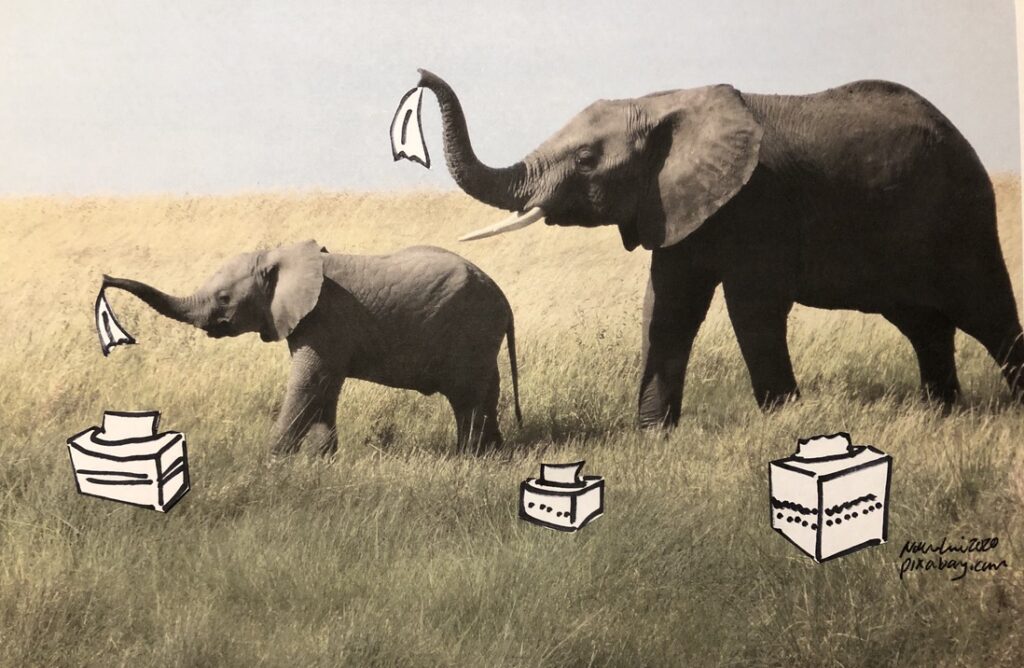
Viral lamentations: imagine an elephant’s woes when a cold ends up in their nose
In the age of the COVID-19 pandemic, we can no longer say easily that your child with cold symptoms has a simple cold. Pre-pandemic, it was so easy to say, “Of course they can go to school with a cold. Most kids can participate and be perfectly happy despite their stuffy nose or mild cough.” We pediatricians often spent time reassuring parents about colds.
SARS-CoV-2, the virus that causes COVID-19 (COVID) infections, is one of many viruses that mainly attack the airways. Most of the viruses cause similar initial symptoms, making it difficult to distinguish one from another. COVID, just like other illnesses, can appear like an innocent-seeming cough, runny nose and a mild fever. Determining if your child has COVID or a cold is trickier than knowing how to tell the difference between a cold and the flu.
“COVID in children can look just like a simple cold.”
Because it is so difficult to tell the difference between COVID or a “regular” cold, your pediatrician may ask you to assume that your child has SARS-CoV-2 and advise them to undergo testing and/or to keep them home. Since they might have COVID, you don’t want your child to pass it along to someone else. A child with COVID could pass it to a child with underlying health conditions. Or their teacher. Or another kid who is otherwise healthy, but then passes it to their own parent who has diabetes. Or to their grandparent who lives with them.
A negative COVID test in your sick child is reassuring. Then you know that their cold may be from another virus, such as rhinovirus or RSV. In this case, after taking into account all factors, your pediatrician might say that your child may go back to school or daycare if their symptoms are improving. However, even if your pediatrician gives the green light, whenever practical, try to keep your children home until that last booger has dried and any cough is gone. If some other child gets a cold, their family will be in the same quandary as yours over the need to test for COVID or isolate/quarantine. (See CDC guidelines here) Besides, even “common colds” can lead to complications, and no one needs more complications in 2020.
The good news
Masking, distancing, and keeping your child home when sick should limit the spread of even simple colds. These practices can decrease the number of times your family members will need to stay home and quarantine.
Vaccine studies to prevent covid are happening right now.
Research into medicine to mitigates the effects of COVID illness is happening right now.
While we cannot rush the science, at least the scientific research that will advance our understanding of COVID is well underway.
In the meantime, please continue to laugh and have fun with your children. We have always said “Don’t get sick,” NOT “Don’t have fun.” Hopefully our new temporary disease-preventing habits of wearing masks and distancing will prevent ALL illness this year, whether COVID or not.
Physical therapist Dr. Deborah Stack brings us quick exercises for kids and teens – Dr. Lai and Kardos
After six months of COVID; yes, it really has been that long already, your family has probably found some favorite outdoor hiking spots or bike routes. But what can you do when it’s too cold or wet outside? How can you combat literally HOURS of kids sitting at computers especially if they only have 30-45 minutes until their next class? Here are quick exercises for kids and teens and a table of caloric expenditure for common activities.
Schedule active movement breaks into their day. Take advantage of that lunch and recess “break” and be an example yourself.
Here are some short burst ideas:
Have a 15-minute dance party
Use your body to make all the letters of the alphabet
Shadow box to some music
Dust off the treadmill or stationary bike in the basement
Play ping-pong
Do a few chores (carrying laundry baskets up and down is great exercise)
Jump rope
Jog in place
Do jumping jacks
Pull out some “little kid games” such as hopscotch or hulahoop
Let each child in your house choose an activity for everyone to try
Do a family yoga video
Walk or “run” stairs…kids can try to beat their prior score for a minute of stairs
Take walking/wheeling/even wheelbarrow laps around the house
Stretch out calves, quadriceps, arms and back…see ergonomics post for counteracting all the sitting
Don’t forget the teenagers; they still need activity too especially if their teams are not practicing or competing. Staff from the Mayo Clinic recommend kids ages 6-17 should have one hour of moderate exercise each day. Exercise can help improve mood (through the release of endorphins), improve sleep and therefore attention (critical with all the online learning), and improve cardiovascular endurance. Here are some numbers to get the kids moving:
All activities are based on 20 minutes and a teen who weighs 110 pounds. The number of calories burned depends on weight. If your child weighs more, he will burn a few more calories, if he weighs less, he’ll burn a few less. Below the table are links to some free and quick calorie calculators on the web so your kids can check it out for themselves. For those attached to their phones, there are web apps too.
Dr. Stack is a board certified specialist in pediatric physical therapy and the owner of the Pediatric Therapy Center of Bucks County, LLC in Doylestown, PA. In addition to treating children ages 0-21 for conditions such as torticollis, coordination, neurologic and orthopedic disorders, she also instructs physical therapists across the country in pediatric development and postural control and is a Certified Theratogs fitter.
Going back to school online? Here’s what pediatricians want you to know
Chances are, because of COVID 19, this school year will look different for your children. Here are your Two Peds’ tips for helping your children if they are learning online this fall.
Start with basics such as setting a sleep schedule. Think about how many hours your child slept during the spring quarantine and over the summer. If they woke up refreshed, that is the optimal amount of sleep they need to be alert during class. Incorporate this into your school year expectations. Falling asleep too late and sleeping too late? Check here on how to get your child’s late schedule under control.
Set up an eating routine. Healthy eating habits have not changed from when you were a child. Stick to the school year schedule of breakfast, lunch, dinner and a morning and afternoon snack – just like at school. Don’t allow the kids to graze. Without structure, children tend to throw off their weight- in fact, kids tend to gain weight more quickly in the summer than during the school year.
Rehearse mask wearing. Even though they attend school at home, your kids will go to the grocery store, see a good friend or get a haircut. Teach them to wear a mask properly so you don’t need to spend time readjusting their masks outside of the house.
Keep up the hand hygiene at home: Washing hands always limits germ spread. WHEN–before and after eating, after using the bathroom, after playing outside, and before and after school, the HOW–soap and water preferred for the duration of time it takes to sing the Happy Birthday song twice, or hand sanitizer if a sink is not available, and the WHY–avoid germ spread. See our post on handwashing.
Prevent neck and back strain from continual computer use: Read these posts on ergonomics and proper computer positioning to prevent your children from feeling like pretzels at the end of the day. Likewise, prevent eye strain.
If you are worried about the amount of additional time your children will spend in front of the computer for entertainment in addition to schoolwork, use the American Academy of Pediatrics’ Family Media Plan tool to create a customized screen time contract.
Create a home learning space that your child can call their own. This will be where your child will complete schoolwork and homework. This is especially important if you child usually spends time doing homework on their bed. You want your child to associate their bed with relaxation and sleep rather than activities that rev up their mind.
Get your child the flu vaccine this fall. Even if you never immunized in the past, this is the year you should. Please see our post on the benefits of the flu vaccine.
Help your child to “roll with the punches.” Change, even happy change, can be stressful for adults. After all, we all know how adults often run around frantically during the winter holidays. If you feel frustrated, angry, or fearful about the pandemic, try to keep the brunt of your own negativity from your children. Kids are often more adaptable than you might give them credit for, but they tend to mimic their parents and look to parents about how to respond to new situations. Seek adult help to prevent your own negative feelings from flowing over and smothering your children.
You can do this. Who taught your children their first words? How to walk? The color of an apple? How to organize their homework? You will still have teachers who will teach the content of a class. Your role, as it always has been, is to provide the best possible learning environment.
No matter how it looks, we wish your family a great start to the school year!
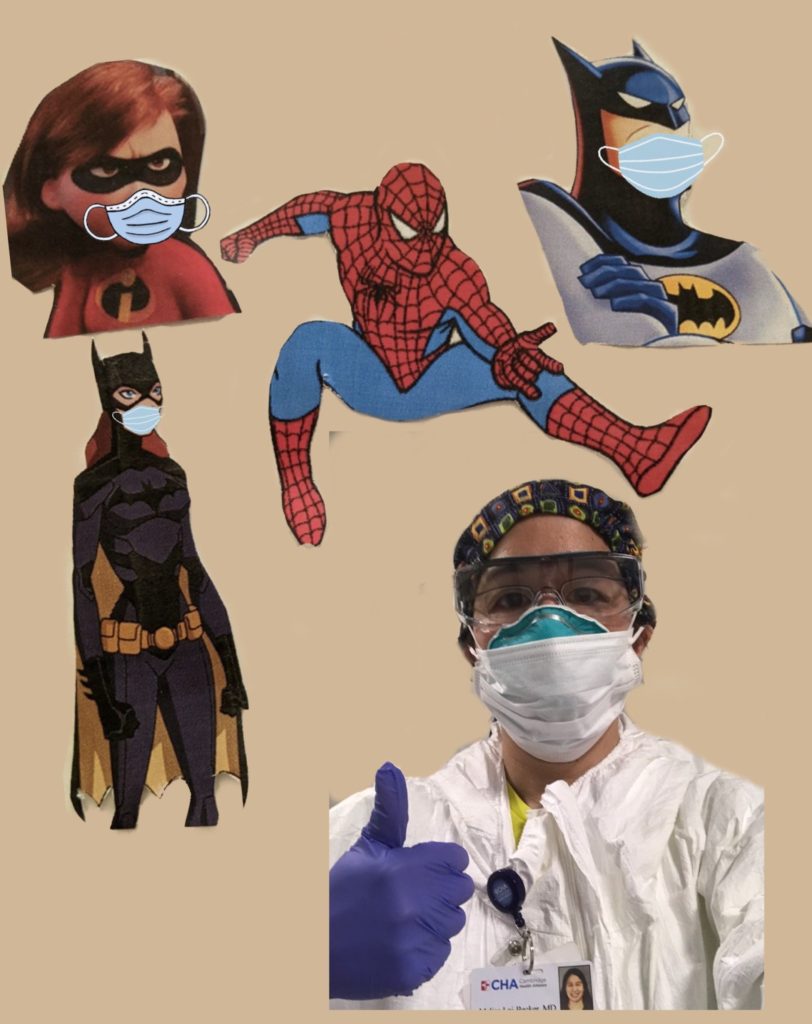
Superheroes don’t wear masks just over their eyes when they fight germs.
Every child, long before COVID, was taught to prevent germs from entering their bodies by washing their hands and making sure their nose did not get too close to other kids’ noses. As we’ve always said, “You don’t want someone’s boogers to jump into your nose.” Besides distancing, wearing a mask is just another way to prevent those boogers from jumping in or out of noses. But most people are unfamiliar with wearing masks and are not sure how to teach their kids to wear them.
Enter superheroes. As we know, superheroes wear masks. Above is a photo of one of Dr. Lai’s favorite superheroes, along side other mask-wearing superheroes. Her superhero sister is an ER doctor. She wears layers to keep herself from bringing home COVID to her own kids. She works in this garb for hours and hours. We borrow from her hints for helping your kids do the same with their masks:
Cover both your child’s nose and mouth with the mask. The path for a germ to enter and exit the lungs is through BOTH the mouth and nose…it’s all connected. If the mask has a wire at the top part of the mask, pinch it over your child’s nose and press gently over the tops of their cheeks. This helps prevent glasses from fogging and also limits germs from coming and going through leaky areas of the mask.
Have your child talk, sing, and jump up and down in their mask before leaving the house. We have seen many a mask wiggle down a kid’s (or parent’s) face as they start to talk. It’s like watching a game of chutes and ladder…the mask goes up a little, and down and little, and sometimes it slides right off.
If the mask seems too big, try tying the loop with a small knot. The secret is to fold the mask in half (lengthwise) with the outsides facing each other and tie a knot close to where the strings meet the paper/fabric. Then pop it back open and tuck the corners in. This works best with a paper mask. Note, masks are not recommended by the American Academy of Pediatrics for those under two years old. Check out other kids who should not wear masks here.
Some kids will complain about the mask. It can be a comfort issue, a fashion issue, or a habit issue. They are just not accustomed to wearing a mask and over time they will get used to it. If comfort were the only goal of kid fashion, gel light-up princess shoes would not exist! Practice having all of your family members wear a mask around the house before venturing out. Also, try your child’s mask on yourself. Maybe the material really is “stinky” or “pinchy” and it’s time for a different mask.
Once a mask is on, teach kids to pull up a mask from the sides or near their cheeks, not near their nose. Again, you want them to avoid touching their boogers.
Taking off a mask correctly is as important as putting one on. When taking off a mask have them wash their hands with soap and water and then gently take their mask off at the ears. If their hands are not washed and they touch their mask around their nose, there is the potential for germy droplets on their hands to jump into their nose.
If you find that ear loops are chafing your child behind the ears or over the cheeks, moisturize an hour before wearing. If you moisturize right before putting on the mask, there is the risk that the mask will slide around. There are all sorts of methods to hook the loops to places other than behind the ears. You can sew buttons on a headband and secure the loops to the buttons or secure the loops to glasses. There are also mask extenders available. Use non-comedogenic (non-acne-producing) lotions such as Cervave®, Cetaphil®, or moisturizers meant for faces only.
If cloth, wash the mask in soap and water when they get home. There is no need to torch the mask with high heat or douse in a special chemical. A good wash with soap and air drying for a day will kill off germs- COVID and other germs as well.
Paper masks need to breathe. Most are technically one time use, but let’s get real, we know that you will use them more than once. Store them in paper lunch bags-fold the masks so the outside (germy side) is touching together.
One final tip: COMPLIMENT your child’s proper mask wearing! Dr. Kardos is often overheard exclaiming to her patients: “I LOVE your mask! It is so COOL! Do you like MINE? See how I wear it LIKE A SUPERHERO?” It is fun to watch the kids immediately put on their masks if they were initially off, and to pull it up over their noses correctly to mirror Dr. Kardos if they had been wearing the mask improperly.
What better barrier against nose spew than wearing a mask? Have your kids wear them in superhero style. Until this pandemic is under control, mask wearing will play a huge role in keeping your children safer from disease spread.
Does the adult looking through the camera at these children see what a child sees? — photo courtesy of Pixabay
No matter your skin coloration, you will have the first opportunity to teach your kids about racism in the United States. To help you approach the topic, therapist Dina Ricciardi culled through the internet to pick out resources to start a dialogue. — Drs. Lai and Kardos
Lately, conversations and news coverage about racism surround us. Images of unrest and violence have covered our news screens, affecting our country, our communities, and sometimes our own homes. On top of the global pandemic of COVID-19, navigating the topic of race and race relations with your family can feel downright overwhelming. Adults may be experiencing a whole range of feelings. Emotions may range from anger to sadness to fear and beyond. While us parents want to teach our kids, we also want to protect them. We wonder, do we talk with them about what they see on television and social media? Or do we shield them from serious problems?
Our understanding and beliefs about race, whether our own race or others’, is deeply personal and rooted in our own unique experiences. As parents, we may feel unprepared and not know how to address our children’s questions and concerns. Therefore, we may avoid conversations about race.
Fortunately, there are many available resources. Many educators, mental health experts, and medical professionals are sharing information to equip us with knowledge and confidence. Below is a handful of the offerings.
These are just a few of the resources available to help you wade into challenging conversations about race. As stated by Dr. Howard Stevenson from the Penn Graduate School of Education, “The more you listen for what your child already knows, what they are concerned about, what they are afraid of, the more you’ll be able to help them speak and feel confident…and keep listening, because your child will need you to keep that conversation going.”
Dina Ricciardi, LCSW, ACSW
Ricciardi is a licensed clinical social worker and psychotherapist in private practice treating children, adolescents, and adults in Doylestown, PA. She can be reached at dina@nourishcounseling.com.